

By Teresa Carballo on 22 October, 2026
Key takeaways
Annual compliance involves separate obligations: accounting records, the annual franchise tax and, for in-scope entities, the economic substance regime. Each has its own deadlines and consequences for noncompliance.
Law 526 applies to Panamanian entities belonging to multinational groups that earn foreign-source passive income. Those entities must maintain the required substance during 2027, ahead of their first return in 2028.
Preparation should begin before year-end: confirm which obligations apply, arrange the necessary personnel and premises, and maintain accounting records throughout the year.
“Economic substance requires traceability: a clear connection between the entity’s income, the decisions made in Panama, and the people and resources supporting its activities.”
Teresa Carballo, partner - Pacífica Legal
Panama’s Corporate Compliance: What changes in 2027?
The fiscal year that closes on 31 December 2026 is the last in which a Panamanian holding company inside a multinational group may treat its foreign dividends as outside Panama's income tax without demonstrating anything about where it is managed. From 1 January 2027, Law 526 of 28 May 2026 conditions that treatment on genuine economic activity in Panama, and its implementing regulation, Executive Decree 32 of 2 September 2026, now sets out what that activity must look like.
Economic substance is only one of the annual obligations of a Panamanian entity. Every company and private interest foundation must also deliver accounting information to its resident agent under Law 52 of 2016 and pay the annual franchise tax (in Spanish, tasa única). These regimes run on different clocks, reach different populations, and carry different sanctions. This guide sets out each obligation, the legal provisions behind it, and a single calendar of key dates through 2028.
Which entities do these obligations reach?
The three regimes do not apply to the same entities, and that distinction is the first thing to settle.
The annual franchise tax applies to every corporation and every private interest foundation registered in Panama, whether active or dormant. The accounting-records regime under Law 52 of 27 October 2016, as amended by Law 254 of 11 November 2021, applies to companies and foundations that operate exclusively outside Panama or that only hold assets. Article 3 of Executive Decree 177 of 30 December 2024 excludes entities that are already taxpayers in Panama, listed entities, entities owned by a State or an international body, and shipowners or charterers in international service.
The economic substance regime is the narrowest of the three. Article 707-A of the Fiscal Code, added by Law 526 of 2026, applies only to entities incorporated or domiciled in Panama that belong to a multinational group and earn foreign-source passive income. Most Panamanian companies and foundations will remain outside it. The obligations that reach nearly everyone, however, begin with the books.
Accounting records under Law 52 of 2016: What to deliver by April 30, 2027?
Article 1 of Law 52 of 2016, as amended by Law 254 of 2021, obliges each covered entity to deliver its accounting records, or a copy of them, to its resident agent within four months after the close of the fiscal year. For fiscal year 2026, the deadline is 30 April 2027.
Executive Decree 177 of 2024 tailors the deliverable to the entity's profile:
At least one foreign beneficial owner (Article 5): financial statements, or a summary of financial position in the model form set out in the Decree.
All beneficial owners are Panamanian, and the entity exclusively holds assets (Article 4): a sworn declaration that the entity generates no taxable income in Panama, together with financial statements or the model form where it generates taxable income abroad.
No activity, no income and no assets throughout the fiscal period (Article 6): a certification or sworn declaration confirming this.
PRACTICAL NOTE
These documents may be signed by an independent director or manager, a member of the foundation council, the beneficial owner, or the beneficial owner's attorney-in-fact. In our practice, a nominee director who acts on the beneficial owner's instructions should not sign them, and a declaration signed in that capacity is the most frequent reason a file is returned.
The "no operations" declaration under Article 6 deserves particular caution. An entity that trades nothing but still holds a balance in a bank, brokerage, custody, or exchange account, or holds a loan receivable, does not qualify for it. Dormancy in the commercial sense is not the test; the absence of any asset is.
The entity must keep its books and supporting documentation for at least five years. If the records are not kept at the resident agent's offices, the entity must inform the resident agent in writing each year who holds them and where. Non-compliance may expose the entity to fines of US$5,000 to US$1,000,000, suspension of its corporate rights at the Public Registry of Panama (in Spanish, Registro Público de Panamá), and forced administrative liquidation ordered by the Directorate General of Revenue (in Spanish, Dirección General de Ingresos or DGI).
The content of these documents is not filed with the DGI. The resident agent instead files an annual sworn declaration identifying the entities that complied, which Article 7 of Executive Decree 177, as amended by Executive Decree 42 of 7 November 2025, requires by 15 July each year. The authorities may nonetheless request the supporting documentation at any time. For a small number of entities, the more demanding obligation from 2027 onward will be the one that follows.
Does Law 526 apply to my Panamanian entity?
Law 526 of 2026 applies only where three conditions are met: the entity is incorporated or domiciled in Panama, it belongs to a multinational group, and it earns foreign-source passive income. If any one of them is absent, the regime does not apply.
Law 526, published in Official Gazette No. 30534-B, added Articles 707-A to 707-Ñ to the Fiscal Code. It seeks to establish sufficient nexus with Panama for entities that benefit from the territorial principle on passive income. Article 707-B(4) defines a multinational group as two or more entities linked by ownership or control and tax resident in different jurisdictions, including the parent, subsidiaries, and permanent establishments. An entity belongs to the group if it is, or should be, included in the group's consolidated financial statements, or is excluded from them only for reasons of size or materiality.
Article 707-C sets out a closed list of six categories of foreign-source passive income: dividends and profit distributions, interest, royalties, capital gains, real estate income, and other income from movable capital. Executive Decree 32 confirms that "entity" is not limited to corporations; limited liability companies, private interest foundations, and trusts fall within it.
The law excludes regulated sectors, including banking and regulated financial entities, insurers and reinsurers, securities intermediaries, managers of investment and pension funds, and entities engaged in the commercial exploitation of Panama-registered vessels (Articles 707-M, 707-N and 707-Ñ). Insurance and reinsurance captives of multinational groups are not excluded.
In our experience, the scope question is most often misjudged in family structures. A Panamanian foundation that holds a Panamanian company, which in turn owns operating subsidiaries abroad, may already satisfy the group definition, depending on where each entity is tax resident. A stand-alone Panamanian company owned directly by an individual, with no related entities abroad, is generally outside it, whatever the source of its income. Once an entity is in scope, the question becomes what it must actually maintain in Panama.
What economic substance is required under Executive Decree 32 of 2026?
Article 707-E of the Fiscal Code requires substance adequate to the nature, scale, and complexity of the passive income, and Executive Decree 32 develops three conditions in Articles 5, 6, and 7. There is no universal headcount or minimum spend; the Decree applies a proportionality standard. The Ministry of Economy and Finance (in Spanish, Ministerio de Economía y Finanzas or MEF) administers and verifies compliance.
Full substance
An entity that does more than hold equity interests or real estate must meet all three conditions cumulatively. Under Article 5, it must employ or engage at least one qualified and remunerated person in Panama whose functions relate to the management, administration, and control of its principal activities, and it must have adequate, documented premises in Panama, whether owned, leased, or shared. Under Article 6, its board of directors or equivalent body must hold at least two meetings per fiscal period with physical presence in Panama, documented in minutes. Directors need not reside in Panama, but these strategic functions may not be outsourced or delegated. Under Article 7, the entity must incur operating costs in Panama proportionate to its activities, separate from payroll and premises.
Reduced substance for holding entities
Article 8 of Executive Decree 32 provides a simplified standard for entities whose principal activity is the non-habitual holding of equity interests in other entities, or the non-habitual acquisition, holding or transfer of real estate. These entities need only satisfy the personnel and premises condition. The Decree presumes the personnel requirement is met where the entity has at least one remunerated director, officer, or administrator who resides in Panama and has adequate experience or qualifications, or other adequate remunerated personnel resident in Panama.
The reduced standard is lost where the entity takes part in the day-to-day operating decisions of its investees, provides financing to unrelated third parties, or performs regulated financial intermediation. A holding company that also lends within the group or actively manages a portfolio should therefore be assessed carefully before it relies on Article 8.
Whether a professional director supplied by a corporate services provider satisfies the presumption will depend on that individual's qualifications and actual involvement. We would not rely on a name in the Public Registry alone.
Outsourcing
Article 707-G of the Fiscal Code and Article 11 of Executive Decree 32 permit the personnel and operating-cost conditions to be outsourced to a provider acting in Panama under the entity's direct supervision and control. Outsourcing performed outside Panama does not count, and a provider's staff time allocated to one entity cannot be counted towards the substance of another. Strategic decision-making under Article 6 cannot be outsourced. Meeting these conditions is necessary but not sufficient; the entity must also report them.
Reporting: The 15% rate and the first return in 2028
Article 710 (paragraph 7) of the Fiscal Code and Article 9 of Executive Decree 32 require an entity in scope to file an annual sworn income tax return with the DGI, including where its only income is foreign-source passive income. Many such entities do not file a return today. The return must include, for each type of passive income, information on the entity's principal activity, personnel, premises, outsourcing, strategic decisions, and related costs. Supporting documentation must be kept in Panama, in Spanish, for five years.
The first return with substance information covers fiscal year 2027 and will ordinarily be due in March 2028, subject to any extension or special rule. The classification applies for each type of passive income and for each fiscal period.
An entity that fails to meet the conditions, or provides incomplete or inconsistent information, will be classified as a Non-Qualified Entity under Article 707-F. Its foreign-source passive income will then be subject to a single and definitive rate of 15% on net taxable income under Article 707-D, with a credit for foreign tax paid under Article 707-H, in addition to fines, surcharges and interest. Article 707-K also allows the MEF, by reasoned resolution, to disregard structures where one of the principal purposes is a tax advantage contrary to the regime, and there are no valid commercial reasons.
Two interactions with Law 52 deserve attention. First, the income tax return falls due in March, before the 30 April deadline for delivering accounting records to the resident agent; an in-scope entity will need its 2027 books closed a month earlier than it is used to. Second, Article 3 of Executive Decree 177 excludes taxpayers in Panama from the resident-agent delivery regime. The DGI has not addressed whether an entity that files a return solely to report substance thereby falls within that exclusion. Until it does, we advise in-scope clients to continue delivering their records to the resident agent.
The annual franchise tax or tasa única
Every corporation pays US$300 a year, and every private interest foundation pays US$400, whether active or not. The due date depends on when the entity was registered at the Public Registry: entities registered between 1 January and 30 June pay by 15 July each year, and those registered between 1 July and 31 December pay by 15 January.
Late payment triggers a US$50 surcharge, and while the entity is in arrears, the Public Registry will not record its corporate acts or issue certificates. According to the DGI, a corporation that leaves three annual payments unpaid is suspended and must pay a US$1,000 rehabilitation fine, plus a US$25 registry duty, to be reinstated. Foundations are not subject to the rehabilitation fine but must remain current.
Forms and Resources
ASSESS YOUR COMPLIANCE OBLIGATIONS
Access Pacífica Legal’s forms and supporting documents to help assess which obligations apply to your entity. This would help you to identify the requirements you must meet, and prepare the information needed for compliance.
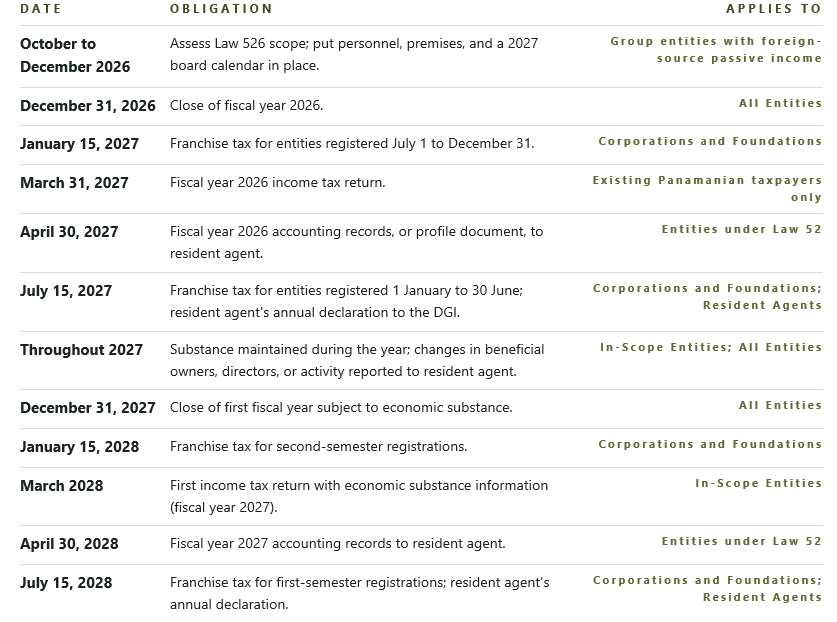
The 2026-2028 Calendar of Obligations
Common failure points
Most compliance failures we see are procedural rather than substantive. The first is the signatory: a declaration under Executive Decree 177 signed by a nominee director will be returned. The second is the misuse of the "no operations" declaration by an entity that still holds an account balance or a receivable. The third is the rebuilding of a year's books in April from bank statements, which is slow, costly and, from 2027, too late for an in-scope entity whose return is due in March.
Under Law 526, the principal risk is retrospective documentation. Minutes recording meetings that did not take place in Panama, or service contracts signed after the fact, will not withstand verification, because the reported information must reconcile with contracts, accounting records, corporate minutes and evidence of expenditure. Substance must exist during the year; it cannot be assembled afterward.
What an entity should do before December 31, 2026
The sequence matters. An entity that classifies its income before confirming that it is the entity receiving that income may solve the wrong problem.
Map the group: identify every related entity, its jurisdiction of tax residence, and whether the group prepares consolidated financial statements.
Determine whether the Panamanian vehicle is actually the entity receiving the relevant income, as opposed to a subsidiary or a related entity elsewhere.
Classify that income category by category under Article 707-C.
Determine whether the entity qualifies for reduced substance under Article 8 of Executive Decree 32 or must meet the full standard.
Put personnel, premises, outsourcing contracts and a 2027 board calendar in place before 1 January 2027.
Arrange for the 2027 books to be kept during the year, so that they are ready for the March 2028 return and the 30 April 2028 delivery2027.
Frequently asked questions
Does Law 526 apply to every Panamanian entity?
No. Law 526 of 2026 applies only to Panamanian entities that belong to a multinational group and earn foreign-source passive income listed in Article 707-C of the Fiscal Code. A stand-alone company owned by an individual is generally outside it.
Can a nominee director sign the accounting-records declaration?
In our practice, no. Executive Decree 177 of 2024 contemplates signature by an independent director or manager, a foundation council member, the beneficial owner, or the beneficial owner's attorney-in-fact.
Do the directors of an in-scope entity have to live in Panama?
No. Article 6 of Executive Decree 32 of 2026 requires at least two board meetings per fiscal period with physical presence in Panama, but not residence. Holding entities relying on the reduced standard generally need at least one remunerated, qualified director, officer, or administrator resident in Panama.
When is the first income tax return with economic substance information due?
The first return covers fiscal year 2027 and will ordinarily be due in March 2028, subject to any extension or special rule.
What happens if the tasa única is not paid?
A US$50 surcharge applies, and the Public Registry will not record corporate acts while the entity is in arrears. After three unpaid years, a corporation is suspended and must pay a US$1,000 rehabilitation fine to be reinstated.
For advice on how this applies to your business structure, contact us at info@pacifica.legal.