
Economic Substance in Panama: Understanding the Executive Decree No. 32

By Joinel Lammie Carvajal on 10 September, 2026
Key takeaways
In-scope entities must now evidence physical meetings and real personnel in Panama, replacing nominee-only structures.
Pure holding and real estate entities get a lighter compliance path but lost it they undertake active participation in operational and commercial decisions.
The income tax return becomes relevant, as it includes eleven compliance points to document economic substance.
Although the Executive Decree No. 32 leaves certain gaps without clear regulation, it offers a guiding framework for understanding economic substance requirements and the necessary evidence to demonstrate a company’s economic nexus to Panama in connection with its activities.
Ninety Days After Law 526: Panama’s Economic Substance Rules Arrive
Following the enactment of Law 526 of May 28, 2026 (the “Law No. 526” or the “Economic Substance Regime”), the Executive Branch planned a ninety-calendar days roadmap to issue the corresponding regulation. On September 2, 2026, the Ministry of Economy and Finance (in Spanish, Ministerio de Economía y Finanzas or MEF) issued the Executive Decree No. 32 of 2026 (the “Executive Decree No. 32”), meeting, in the final stretch of the deadline, the mandate established under the Law No. 526.
Executive Decree No. 32 does not change that rate or the characterization of income it reaches. Its function is different, and in practice more decisive: it specifies what adequate substance means, the threshold of its applicability, what must be proven, where it must be proven, and what documentation must be presented. Article 20 sets its effective date at the fiscal period beginning on or after January 1, 2027, leaving multinational groups with Panamanian entities a window of only a few months to adjust contracts, governance, and files before the first fiscal period subject to the regime begins to run. Consequently, the earliest deadline for Panamanian entities to submit its economic substance documentation will be in March 2028, together with its income tax return for fiscal year 2027.
Who Does the Regulation Reach?
Article 3 limits the scope of application to entities incorporated or domiciled in the Republic of Panama that form part of a Multinational Group and that earn any of the foreign-source passive income categories under Article 707-C of the Tax Code, whether exclusively or together with Panamanian-source income. Accordingly, provided the scope of definition under Article 3, the application encompasses any legal vehicle or legal arrangement, including, without limitation, corporations (in Spanish, Sociedad Anónima), the limited liability company, the partnerships, the trust, and the private interest foundation. Wealth-planning vehicles therefore fall within the text of the regulations whenever they form part of a Multinational Group.
The concept of Multinational Group, however, is not defined by Executive Decree No. 32 itself but by Law 526. Pursuant to the Economic Substance Regime, a Multinational Group refers to two or more entities linked by ownership or control that are tax residents in different jurisdictions, including the parent company, its subsidiaries, and its permanent establishments. Qualifying as an entity is, then, necessary but not sufficient. Without a second link in another jurisdiction, the Panamanian entity remains, in principle, outside the regime even if it earns passive income from abroad.
Three Conditions, Measured by Proportionality
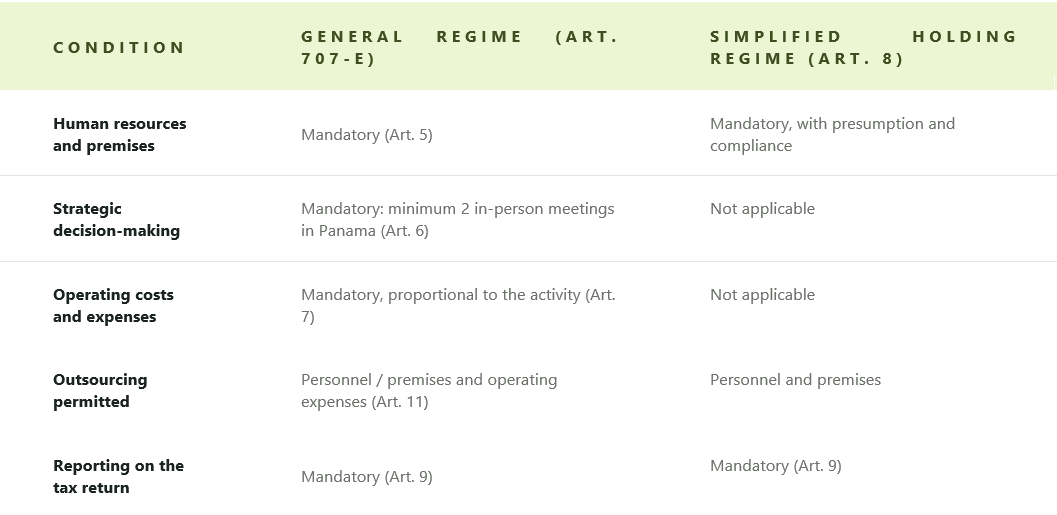
The Economic Substance Regime included Article 707-E of the Tax Code requiring an entity falling within the Economic Substance Regime to meet cumulative conditions: adequate personnel and premises, strategic decision-making in Panama, and proportional operating costs and expenses. Although Executive Decree No. 32 further develops each in Articles 5, 6, and 7, does not establish a threshold other than the minimum requirement of one person. Pursuant Article 4, sufficiency is assessed by reference to the nature, scale, and complexity of the activity, the type and amount of passive income earned, the number of income-generating assets, the degree of risk assumed, and the group's operating structure in Panama.
Adequate human resources and premises (Article 5): qualified, remunerated personnel, employed or engaged under any arrangement, including through service providers, whose role is directly linked to managing the core activity. Premises must be located in Panama, whether owned, leased, or shared, with the right of use documented.
Strategic decision-making and risk support (Article 6): the board of directors or equivalent body must hold at least two (2) meetings with physical presence in Panama during the fiscal period, with documentary evidence of the strategic decisions adopted, kept in Panamanian territory. Article 6 clarifies that, without prejudice to Article 203 of the Commercial Code, this requirement applies solely and exclusively for purposes of this Executive Decree, and expressly bars these functions from being outsourced, delegated, or subcontracted.
Operating costs and expenses (Article 7): expenses proportional to the core activity, distinct from personnel remuneration and premises expenses, accounted for independently.
The in-person meeting requirement is, in practice, the point of greatest friction for the classic Panamanian corporate-services model, built on nominee directors and minutes drafted without any real activity behind them. As of fiscal year 2027, an entity that relies on that model for Article 707-C income will no longer be able to evidence substance with a remote signature: someone will have to travel or reside, and the minutes will have to record verifiable decisions, not boilerplate repeated from one period to the next.
The Simplified Regime for Pure Holding and Real Estate Entities
Article 8 reduces the burden for entities whose core activity consists exclusively of the non-habitual holding of equity interests in other entities or the non-habitual acquisition, retention, or disposal of real estate (the “Simplified Holding Regime”). These entities need only evidence the human resources and premises condition under paragraph 1 of Article 707-E, together with the reporting obligations of Executive Decree No. 32, and are exempted from the board's in-person meetings and from the proportional operating expense requirement.
Article 8 also grants a presumption of compliance: it suffices for the entity to have a remunerated director, officer, or administrator who is a resident of Panama with adequate qualifications, or other remunerated personnel residing in the country with the necessary experience. Outsourcing through service providers in Panama also satisfies this condition. The exemption has a limitation, not merely a nominal one. An entity subject to the Simplified Holding Regime loses the simplified regime, and becomes subject to all three full conditions, if it actively participates in the day-to-day operational decisions of the entities in which it holds interests, provides financing to unrelated third parties, or carries out regulated financial intermediation.
Outsourcing: Contracting Substance
Article 11 allows the personnel and premises condition and the operating expenses condition, never strategic decision-making, to be evidenced through service providers domiciled in Panama, provided five conditions concur: a contractual relationship identifying the expense incurred in Panama; the provider's human resources adequate in number and qualification; the provider's premises proportional and equipped; the activities performed exclusively within Panamanian territory; and documented monitoring and control mechanisms by the contracting entity. When the provider serves more than one entity in the group, its personnel's time may not be counted simultaneously to evidence the substance of more than one of them, which obliges corporate service providers to keep per-client time records.
The Income Tax Return Becomes the Substance File
Article 9, developing Article 707-E and paragraph 7 of Article 710 of the Tax Code, moves the burden of evidencing substance into the annual income tax return and its schedules. The obligated entity must include, among other data, a description of the core activity or activities for each type of passive income; a named list of human resources, with identification document, position, dedication, and remuneration; the amount spent on personnel and premises; the detail of any outsourcing; confirmation that strategic decisions were adopted in Panama; the detail of risks assumed in the country; and, where income derives from intangible assets, a description of the type of intellectual or industrial property involved.
Article 10 requires keeping all supporting documentation in Panama, in physical or digital format, for five years counted from the close of the fiscal period. Article 19 adds a burden that often goes unnoticed until an audit: that documentation must be submitted in Spanish, which requires translating contracts, financial statements, and other supporting records that the multinational group originally keeps in another language.
Foreign Tax Credit and Intangible Assets
Article 12 develops the credit under Article 707-H of the Tax Code for non-qualified entities: the foreign tax must have been effectively paid or withheld on the same income taxed in Panama, must be of a nature analogous to income tax, and its payment must be evidenced with legalized or apostilled documentation. The credit is strictly personal, may not be assigned or carried forward to later fiscal periods, is capped at the tax that would be due in Panama on that same income, and is determined in balboas as of the date it arises, with no later adjustment for exchange differences.
For income derived from intangible assets, Articles 13 through 16 adopt a nexus-style formula: the income subject to special treatment results from multiplying the asset's net income by the ratio between the direct costs and expenses of its development, increased by 30% without exceeding the denominator, and the asset's total costs and expenses. Only intangibles protected by patents, utility models, registered industrial designs, and copyright-protected software qualify; trademarks, image rights, and any other marketing intangible are excluded. The calculation must be made asset by asset, with no offsetting between profitable and loss-making intangibles, and the entity must keep separate accounting records for each.
What a Group with Panamanian Entities Should Do Now
Map which group entities earn income under Article 707-C and verify whether, in the terms of Law 526, a second link exists in another jurisdiction that makes them part of a Multinational Group.
Determine whether the entity qualifies for the simplified regime under Article 8 or must evidence all three conditions under Article 707-E.
Review governance: schedule in-person meetings in Panama, draft minutes documenting verifiable strategic decisions, and update the articles of incorporation or bylaws per paragraph 4 of Article 6.
Formalize in writing the personnel, premises, and, where applicable, outsourcing contracts, with remuneration and the scope of activities clearly identified.
Build, from the first day of fiscal year 2027, a documentary file in Spanish that feeds the eleven items of the income tax return, rather than reconstructing it against the clock at year-end.
The burden of proving proportionality rests with the entity, but that same burden, well managed, is an opportunity: a group that documents each year why its operating expense is reasonable for the type and amount of income it earns arrives at an eventual audit with the argument already built, rather than improvised.
Evidence to be Reported in the Income Tax Return
Panamanian entities falling within the scope of application of the Economic Substance Regime must provide, together with their Income Tax Return, information demonstrating compliance with the economic presence in the Republic of Panama during the fiscal year, and for each category of foreign-source passive income. Such information shall include, among other matters, the following:
General information about the reporting entity.
Taxes paid abroad in connection with such foreign-source passive income, where applicable and when the entity claims a foreign tax credit.
A detailed description of the principal activity or activities carried out to generate each item of the foreign-source passive income.
A list of personnel involved in the entity’s principal activities during the reporting fiscal year, including their general information, functions within the company, whether they work full-time or part-time, and their corresponding remuneration.
The total amount of personnel-related expenses incurred in connection with the individuals responsible for carrying out the principal activities.
A description of the facilities used, and the amount of the associated expenses incurred.
An indication and description of whether the entity outsources the principal activities, where applicable.
Confirmation that strategic decisions relating to the principal activity or activities were conducted or made in Panama – minimum of two (2) meetings of the governance body of the Panamanian entity per year.
Details of the risks assumed within the territory of the Republic of Panama by the entity forming part of the Multinational Group.
Details of the nature and amount of the costs and expenses – differently from the personnel and facility-related expenses – incurred in carrying out the principal activity or activities through which the foreign-sourced passive income was earned during the fiscal year.
Where the income is derived from intangible assets, a description of the relevant type of intellectual or industrial property – each relevant intangible asset must be described individually.
What the Regulation Leaves Unresolved
The regulations do not clarify whether the assets of a single individual, absent a second linked entity in another jurisdiction, allow a Panamanian foundation or trust to qualify as part of a Multinational Group. The question is central to wealth planning, where the Panamanian vehicle is often the only relevant entity and the rest of the structure consists of natural persons.
Article 14 conditions the special treatment of intangibles on assets subject to a registration and approval process before the competent authority, without identifying that authority or the procedure applicable to copyright-protected software. Holders of intellectual property tied to technology projects are left, for now, without a clear registration path before the first affected fiscal period begins to run.
Executive Decree No. 32 grants statutory authority to the Ministry of Economy and Finance for the administration, supervision, and audit of the regime, but does not describe the verification procedure or specific penalties beyond referring to the general rules of the Tax Procedure Code. How the authority will actually audit the sufficiency of declared substance remains, for now, a matter for a later resolution or for the administrative practice that develops during 2027.
The regulation does not specifically address foreign-passive income derived from unregulated activities, such as services and operational activities associated with digital assets. Accordingly, companies forming part of a Multinational Group should adopt a conservative approach by assessing the nature, individually, of any such income received by the Panamanian entity and determining whether it falls within the scope of the Economic Substance Regime.
Questions we are asked most often
What does Executive Decree No. 32 of 2026 require?
It develops the economic substance rules of Law 526 of 2026 for Panamanian entities that are part of a Multinational Group and earn foreign-source passive income, specifying the personnel, premises, governance, expenses, reporting, and documentation needed to preserve the territorial exemption. Additionally, the documentation provided by the Panamanian in-scope entity evidencing the compliance of the Economic Substance Regime must be filed in Spanish.
When do the regulations take effect?
As of the fiscal period beginning on or after January 1, 2027, under Article 20 of Executive Decree No. 32. Consequently, where applicable, the first income tax return evidencing compliance with the economic substance requirements must be filed in 2028.
Can economic substance be outsourced?
Yes, for personnel, premises, and operating expenses, through providers domiciled in Panama that perform the activities exclusively in the country and under the contracting entity's supervision. Strategic decision-making can never be outsourced.
Which entities qualify for the simplified holding regime?
Those whose sole core activity is the non-habitual holding of equity interests or real estate, provided they do not actively participate in the operational decisions of their subsidiaries or provide financing to unrelated third parties.
Where is compliance with economic substance reported?
In the annual income tax return and its schedules, under Article 9 of Executive Decree No. 32, with supporting documentation kept in Panama, in Spanish, for five years.
When does an entity sufficiently comply with the Economic Substance Regime?
Executive Decree No. 32 does not establish a fixed threshold beyond the one-person minimum. Instead, qualifying entities must assess the nature, scale, and complexity of the activities performed in connection with the foreign-source passive income earned. Documenting this assessment is advisable, so the entity can evidence and supports its analysis before the relevant authorities.
For advice on how this adjusts to your corporate structure, contact us at info@pacifica.legal.