
SEC proposes new rules: “Regulation Crypto Assets” - analysis from a Panamanian POV

By Edgar Young on 24 August , 2026
Key takeaways
Two exemptions, a safe harbour that ends investment contract status, and pre-emption of state registration. It is a proposal, open for comment for 60 days.
The $75 million fundraising exemption is closed to non-United States issuers by design. The $5 million startup exemption, as drafted, is not.
Panamanian law is unaffected. The SMV's position rests on the definitions in Decree Law 1 of 1999, not on the Howey test.
A United States rulebook does not travel to Panama. Its vocabulary does, and that is what to watch in the bills now before the National Assembly.
What the Commission proposed on 18 August 2026?
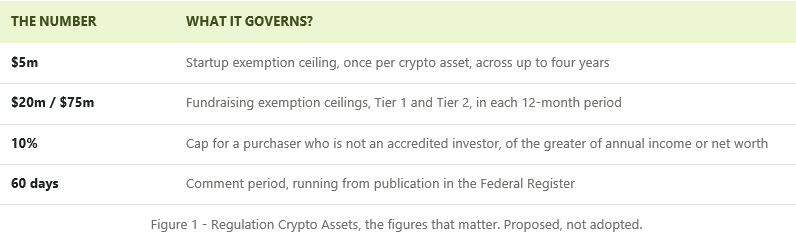
The Securities and Exchange Commission (SEC) approved a proposing release titled Regulation Crypto Assets on 18 August 2026 (Release Nos. 33-11434 and 34-106150; File No. S7-2026-27). It would add a new Part 228 to Title 17 of the Code of Federal Regulations containing two exemptions from the registration requirements of section 5 of the Securities Act of 1933, a conditional safe harbour from the term “investment contract” in the statutory definitions of “security”, and a definition of “qualified purchaser” that pre-empts state registration and qualification requirements. Comments are due 60 days after publication in the Federal Register.
The proposal builds on the Commission’s interpretive release of 17 March 2026, Application of the Federal Securities Laws to Certain Types of Crypto Assets and Certain Transactions Involving Crypto Assets. That release sorted crypto assets into five categories: digital commodities, digital collectibles, digital tools, stablecoins and digital securities. The Commission’s view is that the first three are not themselves securities, that stablecoins may or may not be depending on their characteristics, and that digital securities are.
The object of the new regime follows from that classification. Proposed Rule 100 defines a “covered investment contract” as a contract, transaction or scheme constituting an investment contract where a crypto asset is subject to it, that crypto asset is not itself a security, and no other asset is involved. The security is the arrangement, not the token. Rule 101(e) then supplies the arithmetic that the market has been missing: one unit of the covered investment contract equals one unit of the subject crypto asset, and the price of the contract is determined by reference to the price of the token. No assignment, novation or paper instrument is contemplated. The arrangement travels with the token into the secondary market and remains attached until it separates from the issuer’s promises.
The two exemptions, and the door at the end?
Proposed Rule 200, the startup exemption, would permit offers, sales and other distributions of covered investment contracts of up to $5 million over a period of up to four years, once per crypto asset. The issuer files a notice of reliance on Form NOR before the first covered transaction, publishes principles-based narrative disclosure on a free public website and keeps it current, and files a transition report on Form TR at the end of the period. “Covered transaction” is drafted broadly. It captures airdrops and tokens delivered as a reward or incentive for using, operating, governing or securing the associated network or application, so free distributions consume the ceiling alongside capital raises.
Proposed Rules 300 through 307, the fundraising exemption, are modelled in large part on Regulation A. Tier 1 permits up to $20 million and Tier 2 up to $75 million in each 12-month period, on an offering statement filed on Form 1-CRYPTO and qualified by the Commission, with audited financial statements at Tier 2 and continuing annual, semi-annual and current reports afterwards. A purchaser who is not an accredited investor may not commit more than 10 percent of the greater of annual income or net worth, and unlike Regulation A that limitation would apply at both tiers.
Rule 400 is the provision the market has waited for. Where an issuer has completed or otherwise permanently ceased all essential managerial efforts it represented or promised it would engage in, is making no new representations or promises, and files a transition report on Form TR, the covered investment contract is deemed to have ceased to exist and the crypto asset is deemed not to be subject to it for purposes of the statutory definitions of “security”. The relief runs forward from that filing. It governs the Commission’s administration of the federal securities laws, and the release states that it would not prevent other parties from asserting that a crypto asset is subject to an investment contract or is otherwise a security.
Rule 500 completes the structure. Any person to whom covered investment contracts are offered or sold under Regulation Crypto Assets would be a “qualified purchaser” for purposes of section 18(b)(3) of the Securities Act, which pre-empts state registration and qualification requirements. That pre-emption would extend to secondary transactions by persons other than an issuer, underwriter or dealer for as long as the issuer remains current with its filing and reporting obligations. The regime is non-exclusive, and the antifraud and antimanipulation provisions continue to apply throughout.
Who may use these exemptions, and where Panamanian issuers stand?
Rule 300(b)(1) contains the condition that matters most when the file sits in Panama. To rely on the fundraising exemption, an issuer must be an entity organized under, and subject to, the laws of the United States, or of any state or territory of the United States or the District of Columbia. It must also satisfy three further tests drawn from part of the definition of “foreign private issuer”: a majority of its executive officers or directors must be United States citizens or residents, more than 50 percent of its assets must be located in the United States, and its business must be administered principally in the United States. Blank-check companies, certain acquisition vehicles, investment companies, delinquent filers and bad actors are excluded as well. The Commission is candid about the purpose. It records that regulatory uncertainty has encouraged crypto projects to move overseas, and states that the requirement could help reverse that trend.
The startup exemption is drafted differently. Rule 200(b)(2) provides only that the issuer may be an entity, an individual, or a group of individuals or entities, and imposes no organizational or nexus test at all. Read alone, that would leave a Panamanian corporation or private interest foundation able to file a Form NOR. Read with the release, it is provisional. Requests for Comment 49 and 50 ask whether use of Rule 200 should be limited to entities, whether those entities should be required to be formed in the United States, and whether the citizenship, asset location and administration tests from the fundraising exemption should be imported into it. In our view this is the provision in the proposal most likely to move before adoption, and no offshore issuer should build a distribution plan on the drafting as it stands.
Eligibility is also only half of the question. An issuer that files a Form NOR accepts electronic filing through EDGAR, a public disclosure page that must be amended within 30 calendar days of each year end where the information has materially changed, a closing transition report, and a documented record of the essential managerial efforts it promised. That record is an asset when the safe harbour is claimed later and a liability when the roadmap slips, because the antifraud provisions are measured against it.
What the proposal does not decide?
Regulation Crypto Assets does not determine that any particular token is a security. It addresses the arrangement under which a non-security token is sold, which is the narrower of the two questions founders usually conflate. It is not retroactive, since the relief runs forward from the moment an issuer satisfies the conditions and nothing in it rewrites the status of completed sales. It does not bind private plaintiffs or state authorities exercising antifraud powers. And it is not law: it is a proposal, and a future Commission could adopt it in a materially different form.
It is also silent on tax, which is the omission Panamanian clients notice first. This is a Securities Act rulemaking. It says nothing about the treatment of sale proceeds in the hands of the issuer, the timing of income on locked or vesting allocations, the character and source of amounts received on airdrops and network rewards, withholding on distributions to recipients outside the United States, or information reporting by intermediaries. Those questions are answered in the Internal Revenue Code and in Treasury and Internal Revenue Service guidance, and several of them remain unsettled. A structure that satisfies the Commission may still be the wrong structure after tax, and for most token projects it is the tax answer that decides where the issuer is incorporated.
Does the SEC proposal change the Panamanian analysis?
It does not. Panamanian securities law is positive law and enumerative. The regime is set out in Decree Law 1 of 8 July 1999, as consolidated in the Texto Único of 9 February 2012, and its definitions in Article 1 list what qualifies as a valor. What the definition does not reach is not a security. There is no Panamanian equivalent of the Howey test, meaning no general judicial doctrine that converts an ordinary commercial arrangement into a security because efforts were promised and profits expected. Article 18 of the Constitution supplies the background rule that conduct which is not prohibited is permitted.
The Superintendency of the Securities Market (in Spanish, Superintendencia del Mercado de Valores or SMV) has applied that framework consistently for seven years. Opinion 7-2018 confirmed that it lacks supervisory competence over virtual currencies because they are neither securities nor foreign currency. Opinion 1-2023 reaffirmed the position by reference to the statutory definitions of security and money. Opinion 5-2023 held that crypto assets and crypto derivatives fall outside the regulated activities reserved to investment advisers and brokerage firms. Opinion 4-2025 concluded that a non-custodial platform allowing users to exchange Bitcoin and Ether while retaining their own keys requires no license or registration, and Opinion 01-2026 placed prediction markets outside the scope of securities regulation. The Superintendency of Banks of Panama (in Spanish, Superintendencia de Bancos or SBP) reached the equivalent conclusion within its own mandate as early as 2018.
The consequence is that the Commission’s central move has no counterpart in Panamanian law. A Panamanian issuer has no domestic investment contract problem to solve, and nothing in Part 228 disturbs the opinions on which its local position rests. The proposal becomes relevant to a Panamanian entity at the point where it offers or sells into the United States, and there the analysis is the one it already had. Section 5 applies unless an exemption is available, Regulation S continues to govern offshore distributions, and the March 2026 interpretation describes when the promises attached to a token turn a sale into a securities transaction.
How Panamanian regulators are likely to read it?
Panamanian regulators do watch their counterparts, and the SMV has itself noted that legislative updates would give the market greater certainty. That interest now meets a crowded legislative docket. Draft Bill 247/2025 addresses public policy on the use and commercialization of cryptocurrencies. Draft Bills 326/2025 and 424/2025 each propose a registration and supervision regime for virtual asset service providers built to Financial Action Task Force standards. The Panamanian Capital Markets Association (in Spanish, Asociación Panameña de Mercado de Capitales or APAMEC) submitted a virtual asset draft to the Ministry of Economy and Finance (in Spanish, Ministerio de Economía y Finanzas or MEF) in late 2025. Draft Bill 427/2026 would establish a fintech framework including a license for digital assets and crypto assets. None of them yet shows the alignment between the legislature, the executive superintendencies and the affected industry that material financial legislation in Panama has historically required.
The risk worth naming is one of vocabulary. If a Panamanian draft borrows investment contract language from the United States without the eighty years of case law that gives the term its boundaries, a positive-law system would inherit an open-ended functional test and the market would get less certainty rather than more. The half of the American proposal that would transplant well is the other one. A filed, dated and public point at which an issuer’s obligations end is a sound idea in any legal system, and it is precisely the piece that the Panamanian drafts, which so far concentrate on entry into supervision, do not contain.
In the meantime, the pressure on Panamanian structures is arriving from a different direction. It is supervision of virtual asset service providers aligned to Financial Action Task Force standards, together with the automatic exchange commitments Panama signed at the OECD Global Forum in December 2025 under the Crypto-Asset Reporting Framework, that will change what compliance costs here. Those obligations will bind before any securities question is settled.
Questions we are asked most often
We issue from a Panamanian entity. Can we use the new exemptions?
Not the fundraising exemption. Rule 300(b)(1) requires a United States issuer with United States management, assets and administration, and a Panamanian corporation or foundation cannot satisfy it. The startup exemption as drafted contains no such condition, so on the current text a Panamanian issuer could file a Form NOR. The Commission has asked whether to close that, which makes it a live question rather than a plan.
Does this mean the offshore token issuer is finished?
No. The exemptions matter only for offers and sales that reach the United States, and most distributions are structured to fall outside that perimeter under Regulation S. Panamanian entities continue to perform the functions they always performed: holding the protocol and its intellectual property, operating the front end, contracting with market makers, and issuing to an investor base outside the United States. The question the proposal raises is whether a group adds a United States issuer for a United States raise, not whether it replaces the entity it already has.
What would we take on by moving issuance to a United States entity?
Federal and state income taxation of the issuer, audited financial statements at Tier 2, reporting that continues after the raise closes, and the 10 percent investment limitation on purchasers who are not accredited investors. The United States tax treatment of sale proceeds, vesting allocations and network rewards remains unsettled in material respects. The tax analysis should be obtained in writing, in both jurisdictions, before the securities analysis is allowed to decide the structure.
Do we need to notify the SMV, or revisit our Panamanian position?
No. The SMV’s opinions turn on the definitions in Decree Law 1 of 1999 and are unaffected by a foreign rulemaking. A Panamanian entity’s regulatory position is what it was the day before the proposal was issued, and no filing or notification arises from it.
Is it worth filing a comment?
If the startup exemption is commercially relevant to you, yes. Requests for Comment 49 and 50 are where the eligibility of non-United States issuers will be decided, and comments from foreign issuers with United States users are what the record currently lacks. Comments are submitted under File No. S7-2026-27.
Before the comment period closes
Four steps are worth taking while the proposal is still open, in this order.
dentify which entity in the group actually issues, and where its directors, assets and administration sit. The eligibility tests are answered by facts, not by intention.
Where any part of a distribution reaches United States persons, put the Regulation S and March 2026 interpretation analysis in writing, including the public statements the project has made about what it will build.
Obtain the tax analysis in both jurisdictions before deciding whether a United States issuer belongs in the structure at all.
File a comment under File No. S7-2026-27 within 60 days of publication in the Federal Register if the startup exemption matters to your distribution.
What this means for you?
For Panamanian issuers the immediate effect of Regulation Crypto Assets is close to nothing, and the medium-term effect is real. Nothing in the proposal changes Panamanian law, the SMV’s opinions, or the way a Panamanian corporation or private interest foundation is used within a token structure. What changes, if the rules are adopted broadly as drafted, is that a compliant United States path exists for the first time, and that only a United States issuer may walk the whole of it.
That will turn the choice of issuer into a commercial decision rather than a defensive one, to be settled on tax, investor base and reporting appetite rather than on securities law alone. Groups that expect to raise from United States investors within the next two years should model the United States issuer now, while the comment period is open and the drafting can still be influenced.
For advice on how this applies to your entity, contact us at info@pacifica.legal.