
Dependants of Residents in Panama: Two Routes to Residence.

By Isabella Fernandez on 18 September, 2026
Key takeaways
Panama offers two family reunification permits. The right one depends on the family member´s migration status and on whether the family wants a temporary stay or a path to permanent residence.
The temporary-resident route (PRT-FAM) is capped at six years and does not lead to permanent residence. The permanent-resident route (PPT-7) does.
A dependent may only be a first-degree relative by consanguinity of the applicant.
Both routes turn on the same paperwork discipline. What separates them is where they lead: one keeps the family in Panama for a time, the other opens the door to permanent residence.
The Starting Point
Panama runs different pathways for family reunification. There are two routes that may be relevant for dependants and the first decision in any file is which one applies. Both let a foreign national bring close family into the country, but they are available to different applicants, carry different income requirements, and lead to different outcomes. The National Migration Service (Servicio Nacional de Migración) issues each one, and choosing the wrong category is the most consequential mistake a principal applicant can make before a single document is gathered.
One of these routes is, the Temporary Resident Permit for Family Reunification (PRT-FAM), allows a temporary resident to bring certain family members, including spouse, children and parents, through annual permits for up to six years. The second one is the dependent route for a permanent resident, a provisional two-year resident national (PPT-7), which is initially granted on a provisional basis for two years. After that period, the holder may apply for permanent residence, although approval is not automatic. This guide sets out who qualifies, what each route requires, how the principal applicant proves solvency, and where files fail in practice.
The theme that runs through both is that eligibility is rarely the obstacle. Files fail on documents, not on the family relationship, and the work that decides the outcome happens before submission, not after.
The Legal Basis
Both routes rest on Decree Law 3 of 22 February 2008, which replaced the former National Directorate of Migration and Naturalization with the National Immigration Service and established four migratory classifications for foreigners entering Panamanian territory: non-resident, temporary resident, permanent resident, and foreigner under the protection of the Republic of Panama. Every dependent’s file, on either route, layers on top of the baseline documentary requirements established in Article 28 of that Decree Law.
Executive Decree 320 of 8 August 2008 regulates Decree Law 3 and sets out the category-specific requirements. The permanent-residence dependent route draws specifically on Articles 224 to 226-A of that decree, together with Law 38 of 2000 on administrative procedure. Executive Decree 26 of 2 March 2009 later amended the spousal provision in Article 222 and added a new adopted-dependent track in Article 226-A. so counsel should confirm the current text against the Official Gazzette rather than relying on the 2008 original alone.
The Two Routes at a Glance
The two permits share a documentary backbone and diverge on four points that decide which one a family should file: what is the main applicant status, how long the permit lasts, whether it leads to permanent residence, and the income the main applicant must show.
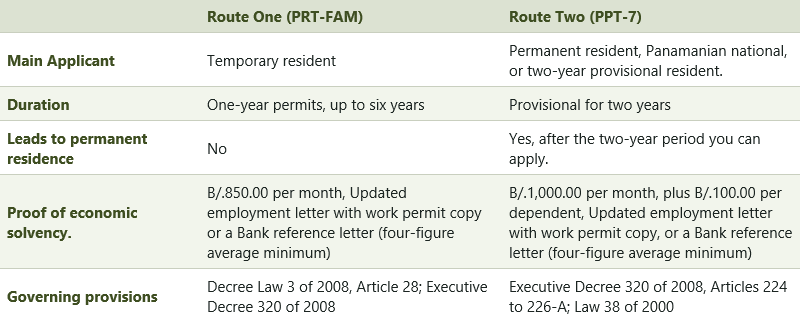
The distinction that matters most sits in the third row. The temporary-resident route keeps the family in Panama but stops at six years. The permanent-resident route is built to convert into permanent status.
Who Qualifies as a Family Member
Both routes cover the same core family: the main applicant foreign spouse, the minor children under eighteen years of age, and the parents. Each also extends to a person under the main applicant´s guardianship or custody, evidenced by a certificate of guardianship or custody and care.
Children between eighteen and twenty-five years of age may qualify on both routes, but only on two combined conditions: they must be enrolled as full-time students at a recognized institution, and they must remain economically dependent on the main applicant. Anyone who meets the requirements must also prove single status, through a certificate of no impediment to marry or, where the country-of-origin issues none, a notarized sworn declaration.
The permanent-residence route reaches slightly wider. It also covers family members with a disability who depend on the main applicant, Ordinarily a dependent would first hold provisional residence (PPT-7) before qualifying for permanent status, but Executive Decree 26 of 2008, carves out an exception for a foreign dependent adopted by a Panamanian, who may apply directly for permanent residence, adding the adopter’s letter of responsibility, a birth certificate from the Civil Registry, an authenticated copy of the adoption judgment, and a copy of the adopted person’s identity document.
Route One: Dependent of a Temporary Resident (PRT-FAM)
The PRT-FAM lets a temporary resident keep the family together without switching categories, on one-year permits renewable up to a total of six years. The National Migration Service’s requirement sheet lists the following as the standard first-time file, presented through a licensed Panamanian immigration attorney:
A notarized power of attorney and application.
Three passport-size photographs.
A copy of the passport, certified by a notary or the competent authority.
A police clearance certificate.
A certificate of good health.
A certified check for B/.250.00 payable to the National Treasury
A certified check for B/.800.00 payable to the National Immigration Service.
A sworn declaration of personal background and a letter of responsibility signed by the temporary resident.
Proof of the family relationship: a birth certificate, a marriage certificate, or a certificate of guardianship or custody and care, as the relationship requires.
The temporary resident must show proof of economic solvency, either a minimum monthly income of B/.850.00, proved through a tax return, an updated work letter with Social Security (Caja de Seguro Social) records or a work permit, or a bank reference letter in the required format. This route is temporary by design. It does not, by its own operation, convert into permanent residence, and when the six-year ceiling is reached the permit does not mature into permanent status. A family member who wants to stay permanently must qualify under a different category, which is the subject of Route Two.
Route Two: Dependent of a Permanent Resident or National (PPT-7)
The second route serves the family of a permanent resident, a Panamanian national, or a provisional resident who has completed two years. The National Migration Service issues it provisionally for two years under Article 224 of Executive Decree 320 of 2008, and after that period the family member may apply for permanent residence. The file repeats the common requirements above and adds two documents specific to the route:
A copy of the main applicant migration card, notarized, or when the person holds a cédula or permanent-resident card, it must be authenticated by the Civil Registry.
For an adopted dependent, the adopter’s letter of responsibility, a birth certificate, an authenticated copy of the adoption judgment, and a copy of the adopted person’s identity document.
Here the main applicant must show a higher income floor: a minimum of B/.1,000.00 per month plus an additional B/.100.00 for each dependent, proved through one of the same three options available on the first route.
The payoff for the higher threshold is the destination. After the two-year provisional period, the family member applies for permanent residence by resubmitting the same requirements, with two exceptions that the permanent-residence stage does not require again: the police clearance certificate and the two certified checks.
Choosing the Right Route
The right route follows from two questions: who holds the qualifying status, and where the family wants to end up. If the main applicant is a temporary resident and the family’s aim is simply to remain together during that stay, the PRT-FAM is the direct answer. If the main applicant is a permanent resident, a Panamanian national, or a provisional resident who has completed two years, and the family intends to settle, the PPT-7 route is the one that leads to permanent residence.
The two routes are separate procedures, not stages of one path. The PRT-FAM does not turn into the permanent-residence route, and time spent on it does not count toward permanent residence. If the temporary resident later becomes a permanent resident or a national, the family member cannot transfer or continue; they must file a new, independent application under the PPT-7 route, meeting its own requirements from the start. The route available at any moment follows the resident's status at the time of filing.
Questions we are asked most often.
How long does the PRT-FAM last?
The National Migration Service issues the permit for one-year periods, renewable up to a total of six years. When the six-year ceiling is reached, the permit simply ends; it does not convert into permanent status.
Does the temporary-resident permit lead to permanent residence?
No. The PRT-FAM is temporary and stops at six years. A family member seeking permanent residence must qualify under the permanent-residence dependent route or another category.
What income must each main applicant show?
A temporary resident must show at least B/.850.00 a month. A permanent resident or national must show at least B/.1,000.00 a month plus B/.100.00 for each dependent.
Who can be considered as dependents?
A foreign spouse, children under eighteen, children eighteen to twenty-five who study full-time and remain dependent, dependent parents, and a person under the main applicant´s guardianship. The permanent route also covers dependent family members with a disability and adopted dependents.
Can adult children qualify as dependents?
Yes, between eighteen and twenty-five, provided they are enrolled full-time in a recognized institution, remain economically dependent on the main applicant, and prove single status.
Before the next cycle
Confirm which route matches the main applicant status before assembling any file, since the income floor and destination differ.
Verify that every kinship and solvency document is current, apostilled or authenticated, and consistent across the file.
Confirm each certified check names the correct payee and the exact amount before submission.
File through a licensed Panamanian immigration attorney and track each certificate’s validity period.
What this means for you
Family reunification in Panama is administratively simple once the file is complete, but it is not a single procedure. It is two, and the choice between them shapes everything that follows: the income the main applicant must document, how long the permit last, and whether it ends in permanent residence or simply expires at six years.
The work that decides the outcome happens in the weeks before filing. A file built on the right route, with the correct income threshold, kinship evidence that names the correct category, and checks issued to the correct payees, moves through the National Migration Service without the back-and-forth that turns a sixty-day process into a six-month one. Choosing the route is where that work begins, and it is where counsel earns its place.
For guidance on your specific circumstances and the family reunification process, contact us at info@pacifica.legal