
New Update: Qualified Investor Visa in Panama

By Ami Ahir Ali on 01 October, 2026
Updated October 01, 2026, to reflect Executive Decree No. 17 of 8 September 2026.
Key takeaways
The Qualified Investor Program still offers a direct route to permanent residency in Panama through a qualifying investment, without a provisional residence stage.
Executive Decree No. 17 of 8 September 2026 replaces the framework in force since 2020. Real estate no longer has a single threshold: a first-sale property still qualifies at US$300,000, but a secondary-market property now requires US$500,000.
Applications filed before 16 September 2026, and investments or contracts perfected before that date, may still use the prior thresholds if the residency application is filed within six months, that is, on or about March 2027.
The Qualified Investor Program allows international investors to obtain permanent residency in Panama through a qualifying investment.
From Investment to Residency
In Panama, the Qualified Investor Program remains particularly well suited to individuals and families seeking to establish a stronger long-term connection to the country through a significant qualifying investment. It continues to attract international investors who wish to combine permanent residency with an investment in Panamanian real estate, securities or other qualifying assets. What distinguishes the program from most other residency routes in Panama is its direct path to permanent residence.
Executive Decree No. 722 of 15 October 2020 created the Qualified Investor subcategory within Panama's broader Permanent Resident by Economic Reasons category. Executive Decree No. 109 of 13 October 2022 then adjusted the promise-of-sale route, and Executive Decree No. 193 of 15 October 2024 fixed the real estate minimum at US$300,000 and added that an investment can be held jointly by the applicant and a spouse or dependent.
Executive Decree No. 17 of 8 September 2026, among other changes, it sets different minimum investment thresholds for first-hand sales and secondary-market real estate. For real estate investments, the qualifying amount is based on the price recorded in the deed or, where an appraisal is required, the lower of that price and the appraised value, less any applicable mortgages or liens. It also reduces the minimum fixed-term deposit from B/.750,000 to B/.500,000 when the deposit is placed with Banco Nacional de Panamá or Caja de Ahorros.
Qualifying Investment Routes
Panama's Qualified Investor Program now offers five ways to qualify for permanent residence, reflecting the split of the real estate route into two tiers. Each route carries its own minimum, documentary requirements and holding period.
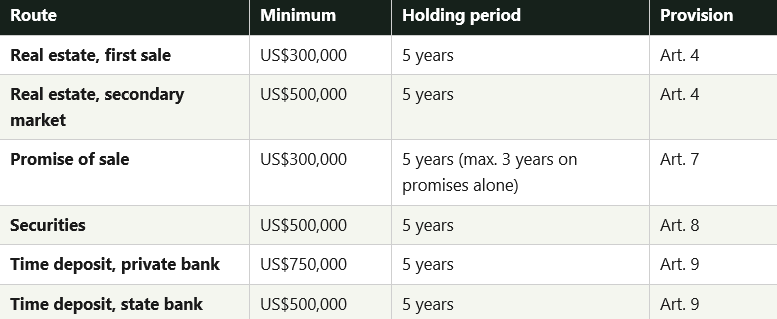
Route 1: First-Sale Real Estate Investment
An applicant may qualify by investing at least US$300,000 in the initial acquisition of a new, unoccupied property transferred by the developer, promoter or its successor. First-sale status must be evidenced by a Public Registry certificate and, where applicable, construction or occupancy permits.
Route 2: Secondary-Market Real Estate Investment
A property that has previously been sold, occupied, leased or transferred to an unrelated third party now requires a minimum investment of US$500,000. This is the most consequential change in the decree for buyers: a resale unit that would have qualified at US$300,000 under the prior regime no longer does. In both tiers, Articles 5 and 6 fix the recognized investment as the lower of the price actually paid and the commercial value reasonably established, net of any real lien affecting the property, so a buyer who pays above the threshold on paper does not necessarily meet it in substance.
For route 1 and route 2, related to Real Estate Investment, Article 5 establishes rules that apply to both real estate investment options. The property’s qualifying net value must meet the applicable minimum and is calculated using the lower of the amount actually paid and its reasonably substantiated market value, less the outstanding balance of any liens. Applicants may finance the portion of the purchase price above the minimum, provided the financing is documented and traceable and the net value remains sufficient. The property may be held through a legal entity or private interest foundation, subject to proof of its ownership structure, beneficial ownership and the applicant’s effective control. Applicants must also show that the required investment was made with funds from a foreign source.
Route 3: Real Estate Investment through a Promise of Sale
An applicant may also qualify through an investment of at least US$300,000 under a promise-of-sale agreement for real estate, including property that has not yet been built, segregated or registered. The investment may be made through a deposit held in trust by a bank or trust company licensed in Panama, or by paying 100% of the property price to the developer or promissory seller. In this case, the agreement must be backed by an irrevocable and unconditional bank instrument payable on first demand, such as a standby letter of credit, an irrevocable bank guarantee, or a bank performance guarantee. The instrument must cover at least the amount invested and remain valid until the property has been built, segregated, and registered in the applicant’s name. The instrument must also be renewed and submitted to the Ministry of Commerce and Industries on an annual basis until these requirements have been met.
If the sale is not completed within the agreed period for reasons attributable to the developer or promissory seller, the investor may replace the investment within 180 business days, counting from the business day following the contractual deadline. A replacement promise-of-sale agreement may be used only once. Residency based exclusively on promise-of-sale agreements cannot exceed three cumulative years, whether continuous or discontinuous; exceeding that period without registering the property or replacing the investment as required results in cancellation of the residence permit.
Route 4: Securities Investment
An applicant may qualify by investing at least US$500,000 in qualifying securities through a securities firm or broker-dealer house licensed by Panama's Superintendency of the Securities Market. The Decree expands the types of eligible investments to include not only securities issued by locally listed issuers, but also private equity and venture capital funds focused on productive investments in Panama, debt instruments issued or guaranteed by the Republic of Panama, and registered corporate securities, such as shares, corporate debt, mutual funds, and real estate investment funds. The investment must remain in place for at least five years from the date it settles in the account. A market decline that is not attributable to the investor does not by itself breach the minimum, so long as there is no voluntary withdrawal, disposal or encumbrance and the shortfall is cured within 90 calendar days after the Ministry of Commerce and Industries notice.
Route 5: Fixed-Term Bank Deposit
A fixed-term deposit of at least US$750,000 with a privately owned bank holding a general banking license from the Superintendency of Banks of Panama continues to qualify, unchanged in amount. The Article 9 adds a second, lower-cost option: a deposit of at least US$500,000 placed directly and exclusively with the National Banks of Panama (Banco Nacional de Panamá or with Caja de Ahorros), both state-owned institutions. Under either option the deposit must remain in place for a minimum of five consecutive years, free of liens, pledges or third-party encumbrances, and its foreign origin must be documented through the international transfer evidence the decree requires.
Regardless of the route selected, the investment must be made with funds originating from a foreign source and may be held personally or through a legal entity.
Source of Funds and Ownership Structure
Decree 17 of 2026 adds an express rule that the prior framework left implicit. Article 2 requires that the investment be made with the applicant's own funds, with ownership and traceability documented, and excludes amounts received as a gift, donation or other gratuitous transfer from an unrelated party from the qualifying minimum.
Each principal applicant must generally demonstrate the minimum individually or through an investment maintained jointly by the principal applicant and a spouse or dependent on the same application may be counted as one under the decree's co-ownership conditions.
Process and Timeline
The program continues to offer a direct path to permanent residency, without a provisional residence period. An application may be filed through an authorized attorney before the applicant and any dependents enter Panama.
Article 15 replaces the single 30-business-day figure quoted under the prior decree with two sequential periods. The Ministry of Commerce and Industries has up to 15 business days from admission of a complete file to issue the Investment Certification and the National Immigration Service then has up to 30 business days from receipt of the complete file to resolve the residency application. An incomplete file does not start either clock: the applicant has 15 business days to cure a deficiency, or the file is archived.
Once granted, the qualifying investment must be maintained for at least five years. Article 12 requires the resident, through counsel, to file annual evidence with MICI within the 30 calendar days preceding the anniversary of the immigration resolution. If the investment is sold, substituted or otherwise ceases to qualify before the five years elapses, the resident must notify the Ministry of Commerce and Industries within 30 calendar days after the event, and the Ministry of Commerce and Industries may grant up to 90 calendar days to document an equivalent reinvestment before considering cancellation.
Transitional Rules for Investments Made Before September 16, 2026
An application already filed before 16 September 2026 continues to be governed by the requirements, conditions and amounts in force at the time of filing. Separately, an investment or binding contract perfected before that date may still benefit from the prior regime, provided that the corresponding application is filed within six months from the decree’s entry into force. An Investment Certification already issued will remain effective until its expiration.
Qualified Investor vs. Other Panama Residency Options
Panama offers several pathways to residency, and the appropriate route still depends on the applicant's nationality, family circumstances, investment plans and desired timeline.
For nationals of eligible countries, the Friendly Nations category may offer a lower-cost investment alternative, including a real estate route based on a minimum investment of US$200,000, though it involves an initial two-year provisional residence period before the applicant may apply for permanent residency. By contrast, the Qualified Investor Program requires a higher investment but continues to provide a direct path to permanent residency without that provisional stage.
Key Questions for Qualified Investors
Does a US$300,000 resale property still qualify?
Generally, no. Under Article 4 of Decree 17, a property that has been previously sold, occupied, leased or transferred to an unrelated third party is treated as secondary-market and now requires a minimum investment of US$500,000. Only a new, unoccupied first-sale property still qualifies at US$300,000.
I signed a purchase contract before September 16, 2026. Do the old rules still apply to me?
Possibly. Article 19 allows an investment or binding contract perfected before that date to rely on the prior thresholds, but only if the residency application is filed within six months of the decree's entry into force, on or about 16 March 2027. The protection attaches to timely filing, not to the date of the contract alone.
Does the property have to be purchased entirely with the investor's own funds?
Financing above the applicable minimum remains permitted, but the amount required to meet the US$300,000 or US$500,000 threshold must be free of liens and, under Article 2, must originate from the applicant's own funds.
Does Qualified Investor residency automatically lead to Panamanian citizenship?
No. The program grants permanent residency, not citizenship. Naturalization remains a separate process available after five consecutive years of residence, and Article 14 now routes a qualified investor's application through a dedicated MICI certification window, without reducing the constitutional requirements.
What this means for you
The Qualified Investor Program still offers international investors a direct and flexible path to permanent residency in Panama, but Decree 17 makes the choice of investment route, and the timing of the application, materially more consequential than before. An investor evaluating a resale property should confirm the recognized value before signing, not after.
For advice on how this applies to you, contact us at info@pacifica.legal