
Registration as a Means of Payment and/or E-Money Issuer in Panama

By Joinel Lammie Carvajal on 08 October, 2026
Key takeaways
The registration before the Superintendency of Banks of Panama formalises an issuer’s status for AML/CFT supervision; it is not a dedicated license for payment services or electronic-money issuance.
The business model and flow of funds guide classification and filing requirements.
Registered entities are subject to ongoing AML/CFT controls and assessment.
Although the current regulatory framework does not establish a standalone and dedicated licensing regime for these activities, understanding the scope of application of the Superintendency of Banks of Panama and its registration process is essential to structuring a payment or electronic-money business in Panama.
The distinction between licensing and registration
As of today, fifteen companies appear on the Superintendency of Banks (the “SBP”) list of means of payment and/or e-money issuers updated on 15 September 2026, the earliest registered in 2026[1]. These registrations place the entities within the SBP’s Anti-Money Laundering and Counter-Financing of Terrorism (the “AML/CFT”) supervision framework.
Accordingly, these entities should not be treated as licensed entities for payment services or electronic-money issuance, since there is no dedicated prudential license under the current regulatory framework; rather, their registration formalises their status as entities subject to the SBP supervision for AML/CFT purposes. Whether the business requires additional registrations, licenses or authorisations depends on the activities performed by the company.
What does registration with the Superintendency of Banks of Panama mean?
Pursuant to Article 22(1)(g) of Law 23 of April 27, 2015, as amended (the “AML/CFT Regime”), issuers of means of payment and electronic money are financial reporting entities (in Spanish, sujetos oblgiados financieros). As mentioned in previous paragraphs, registration formalises their status before the SBP, which supervises them exclusively for the prevention of money laundering, terrorist financing and the financing of proliferation of weapons of mass destruction.
This registration does not constitute, in itself, a license; nor does it establish a capital requirement or a regulatory framework for safeguarding customer funds. The AML/CFT characterization of the registration does not prevent the SBP from requesting information about how customer funds will be held and managed. Such a request should be distinguished from a generally applicable safeguarding regime. The foregoing is consistent with the World Bank’s November 2023 Financial Sector Assessment Program identifying gaps in the protection of electronic-money customers' funds and recommending addressing them through a broader payment system legal and regulatory framework.
On that basis, the SBP defines a means of payment as any tangible or intangible instrument that lets a person obtain money, goods or services, make payments or transfer money. It defines e-money as prepaid monetary value represented by a claim on the issuer, stored electronically, issued against funds of at least equal value, accepted by parties other than the issuer, and convertible into cash or its equivalent. The classification matters because it fixes which registration the applicant seeks.
Does Panama require a license to issue electronic money?
No. Under the current framework, payment processors and e-money issuers must register with the SBP to comply with the AML/CFT Regime, but they need no license to carry on the activity. Pursuant to Article 19 of the AML/CFT Regime, the Superintendent of Banks is designated as a supervisory authority. Within this framework, the SBP formalises registration through an administrative resolution, exercising the supervisory authority under the AML/CFT Regime.
As mentioned in previous paragraphs, AML/CFT supervision should be distinguished from a dedicated license for payment services or electronic-money issuance. Under the existing registration framework, applications must therefore consider how the SBP will classify their business model, what supporting documentation it will request, and which ongoing compliance obligations will apply. In that sense, under these circumstances, it leaves the practical question of what the registration process involves.
How the registration process works
As of the date of this article, the SBP has not publicly published a rule setting out a dedicated registration procedure or a standard public checklist for this category. Requirements should be confirmed and assessed for each applicant and business model. However, similar registration procedures may provide a useful reference for understanding how the process works in practice. The SBP’s index of agreements for other financial reporting entities includes registration procedures for money remitters and exchange houses under Agreement 1-2008 and 2-2018, both published in Official Gazette No. 28612-B of September 14, 2018.
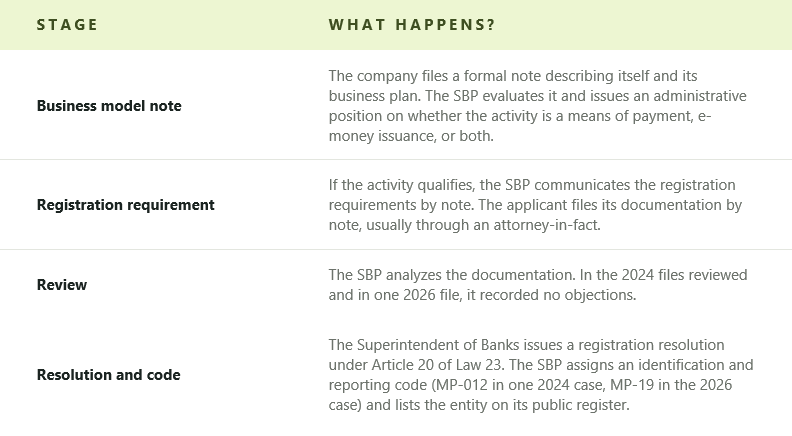
The Superintendent of Banks issues a registration resolution under Article 20 of Law 23. The SBP assigns an identification and reporting code (MP-012 in one 2024 case, MP-19 in the 2026 case) and lists the entity on its public register.
Counsel should treat the first note as the substantive filing, because the SBP's administrative position on classification drives every later requirement. The applicants in the resolutions reviewed described very different businesses: a card-acceptance payment facilitator, a cross-border collection provider, and a digital payment intermediary offering payment links and QR codes. All three were registered as means of payment issuers. Describing the product by its money flows, meaning who receives funds, who holds them, and when they are released, serves the applicant better than describing it by its technology.
What documentation does the Superintendency of Banks of Panama require?
The SBP communicates the documentation by note once it has classified the activity, and it publishes no list. In Pacifica Legal's experience, the set comprises eight items, and an applicant should begin assembling them before the first note is filed:
Business model and operational controls. A description of the business with its anti-money-laundering controls, stating the roles of the company and of the function that will run compliance. It must cover the customer due diligence information to be requested; the process for identifying and validating the source of funds; monitoring, alert detection, handling of accumulated alerts and transaction tracking; the operational amount to be managed and how it is controlled; and a risk assessment of new products and technologies.
Public Registry certificate of the company issued not more than three months before filing.
Shareholder certification issued by the company secretary, identifying the shareholders and beneficial owners, the number of shares and the percentage each represents, with a copy of the identity document or passport for foreign persons.
Business plan covering mission, vision and strategic objectives; a detailed description of products and services; the customer identification system and monitoring procedure; a Panama market analysis; marketing; and the organizational structure, including positions, names of responsible persons, headcount and the operational scheme.
Designation of the person responsible for compliance in prevention matters.
Certification of the financial mechanism or instrument that will safeguard and manage client funds.
Sworn declaration made before a notary public, in which a Certified Public Accountant certifies the source and origin of the resources forming the company's working capital. It must attach supporting documents for contributions and other capitalization schemes and state that the information is complete and contains no false representation or material omission.
Process flow and organizational chart of the company.
From the foregoing list, two items would require early preparation: the certification describing how client funds will be held and safeguarded and the sworn declaration on the source of working capital, which requires an external accountant and may depend on records held abroad. Both can affect the filing timetable. This list reflects the firm’s experience, including related card issuer or processor registration, rather than a published SBP rule, and requirements may vary by business model.
How long does registration take?
The published resolutions show a wide range, and the sample is small. The resolutions reviewed show approximately seven months between the cited documentation-submission dates and registration in two 2024 cases, and approximately one month between expressly recorded completion of documentation and registration in a 2026 case. These examples are not statutory deadlines or reliable estimates for future applications but provide us with practical insight into how the Superintendency of Banks of Panama treats these applications.
What does registration cost?
Under the current regulatory framework, we have not identified a publicly available fee schedule specifically for the registration itself. Separately, Agreement for Other Financial Reporting Entities No. 03-2018, published in Official Gazette No. 28612-B of September 14, 2018, establishes the framework for inspection costs. These costs are allocated considering, among other factors, the entity’s assets, the volume and complexity of its operations, and its geographical dispersion. Applicants should confirm the applicable charges directly with the SBP during the registration process. Applicants should also budget for the third-party costs associated with preparing the required documentation, including the Public Registry certificate, notarised declaration and accountant’s certification, as well as the ongoing costs of maintaining the compliance programme required under the AML/CFT Regime.
Obligations after registration
Once registered before the SBP, the registered issuers must comply with the AML/CFT Regime, as amended, including the Agreement No. 5 of May 26, 2015 (the “Agreement 05-2015”), concerning the prevention of misuse of services provided by other reporting entities under SBP supervision. These obligations include customer due diligence, identification and verification of beneficial owners, risk assessments, ongoing monitoring, records retention, and suspicious-transaction reporting. Pursuant to Article 2 of Agreement 05-2015, entities are required to adopt the measures necessary to prevent their operations or transactions from involving funds linked to money laundering, terrorist financing, or proliferation financing.
The issuer registration resolutions reviewed, including Resolution SBP-PSO-R-2026-00365, expressly relied on this Agreement. By comparison, Agreement No. 1 of January 16, 2026, expressly applies to banks, fiduciary companies and specified banking groups and should not be assumed to govern payment or electronic-money issuers solely because they are registered before the SBP.
Issuers must also assess whether changes to their business model require an additional registration. Article 2 of Resolution SBP-PSO-R-2024-00010 requires the registrant to notify the SBP when a change introduces other activities subject to its AML/CFT supervision, so that the corresponding registration code can be obtained. Resolution SBP-PSO-R-2026-00365 contains the same requirement. Accordingly, the business plan, process flow and supporting documentation submitted during the application establish the activities covered by the registration. An existing registration should not be treated as automatically covering additional activities introduced after it is granted.
Common registration challenges
Misclassification: An applicant that describes itself as a technology platform, without stating how funds move, invites a slow exchange of notes.
Treating the registration as a license procedure: The SBP's own register limits supervision to anti-money-laundering matters, and an issuer that tells customers or banks it is authorized to hold funds misstates its status.
An unprepared safeguarding or source-of-funds file, which stalls an application that is otherwise complete.
A registered payment facilitator that begins remitting money, or exchanging currency, without the corresponding registration under Rules 1-2018 or 2-2018, will be operating outside the scope of the resolution it holds.
A legislative attempt to regulate fintech activities
Draft Bill 314, presented on January 13, 2026, reflected an intention by the National Assembly to establish a broader regulatory framework for fintech activities in Panama, including payment services and electronic-money issuance. The proposal contemplated differentiated licensing categories and a more comprehensive supervisory framework, extending beyond the AML/CFT registration. Had those provisions become law, affected providers would have needed to assess the applicable licensing requirements and any transitional arrangements for entities already registered with the SBP.
This initiative was subsequently adopted for legislative consideration as Bill 487 but was withdrawn by its sponsor on April 21, 2026, according to the National Assembly’s legislative record. Its proposed licensing framework therefore did not become law through the process and does not alter the registration framework described above. Although the proposal illustrates an interest in broader fintech regulation, any future legislation would need to be assessed on its own terms, including its scope, treatment of existing registrations and implementation timetable.
Questions we are asked most often
Is the Superintendency of Banks of Panama registration a license to issue e-money?
No. It registers the company as a financial reporting entity for anti-money-laundering supervision under the AML/CFT Regime. The SBP supervises these entities exclusively for that purpose.
Who approves the registration?
The Superintendent of Banks, acting under Article 19 of the AML/CFT Regime, approves the registration by a resolution that assigns the entity an identification code.
What documents does the Superintendency of the Banks of Panama require?
The SBP publishes no list. In the firm's experience, it requires the business model with AML controls, a Public Registry certificate, a shareholder certification, a business plan, a compliance officer, client-funds safeguarding certification, a notarized source-of-funds declaration, and a process flow.
How long does registration take?
The SBP's review took about seven months in two 2024 files and about one month in a 2026 file, measured from a complete filing. Preparing the documentation can take longer than the review.
At Pacífica Legal, we advise payment and e-money providers on classification, filing, and the compliance program that follows. Contact us to assess whether your business model requires registration at info@pacifica.legal.
[1] Superintendency of the Banks of Panama, “Means of Payment and/or E-Money Issuers”. List available at https://www.superbancos.gob.pa/otros-sujetos/medios-pago